
Project Management
Editorial Calendar
Platform
Asana
Overview
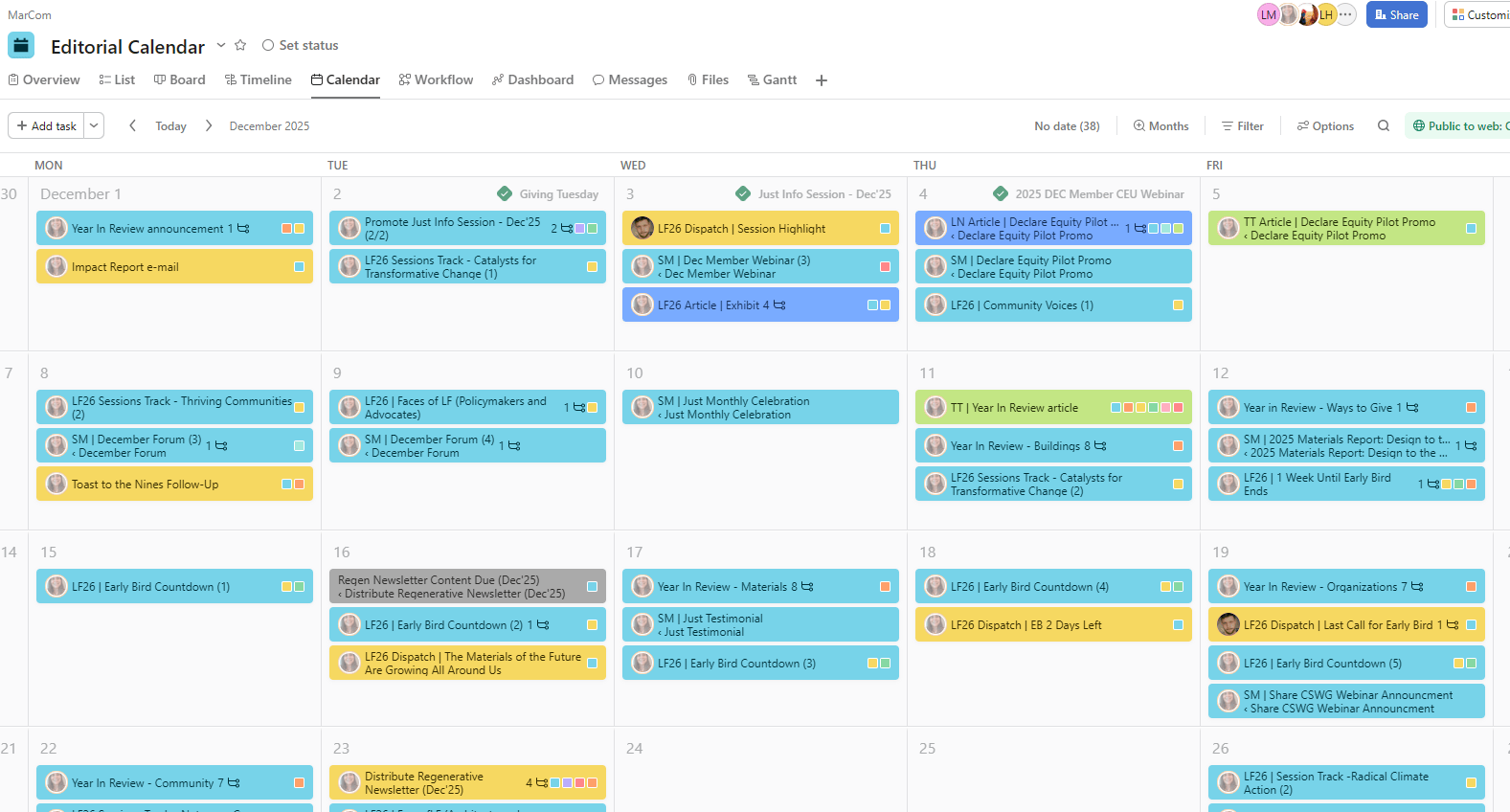
One of my first projects at the International Living Future Institute (ILFI) was to create an organizational wide Editorial Calendar to track all public facing communications. In the process, I streamlined and automated the interdepartmental work request infrastructure, cutting down submission request time by 75%.
Challenges
When I joined the ILFI team, there had been an attempt of creating an interdepartmental editorial calendar using the organization’s project management software, Asana. However, it had been intermittently used and required manual maintenance. Further compounding the issue was a complicated request ticketing process, making the tracking of marketing requests confusing for departments—and the marketing team!
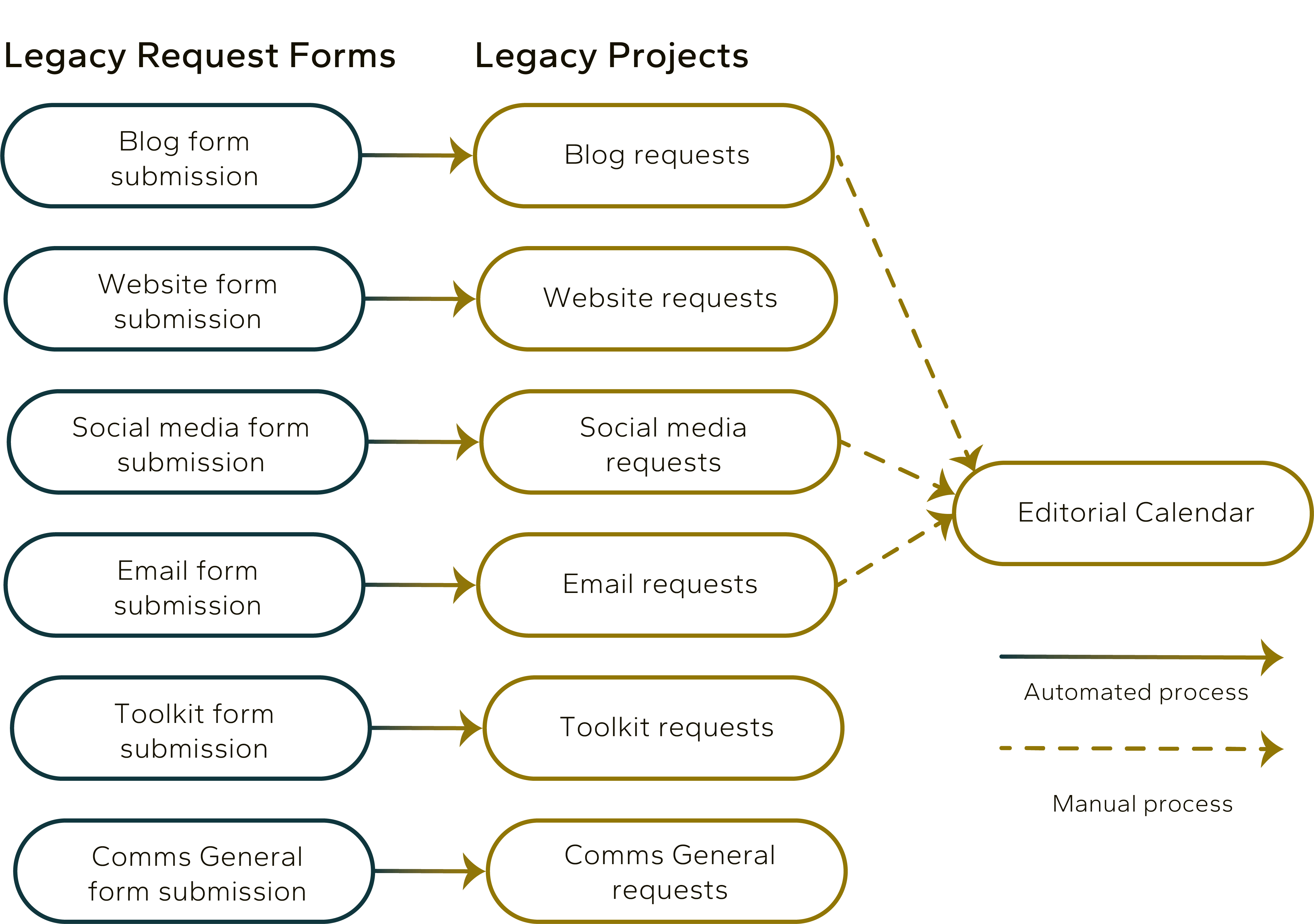
There were six teams that required marketing and communications support for the majority of public facing communications. Perhaps in a subconscious attempt for symmetry, there were six different marketing request forms teams would have to fill out. The various forms had repetitive fields and it was time consuming for staff to fill out, especially if they were trying to promote something on multiple platforms.
There was basic automation in place to auto-assign tasks to relevant team members when a disparate form was completed; however, relevant requests had to be manually added to an organizational-wide editorial calendar. If somebody submitted requests for more than one platform, they often had to go to different projects, each with their own link, in order to check status for each piece of their request.
A lot of things fell through the cracks, such as having two different teams trying to send an email to the same listserv on the same day. Additionally, when working on campaigns with teams, the process fragmented tracking, request fulfillment, and metrics reporting.
Legacy Workflows
Solutions
Updating the workflow that informed the Editorial Calendar required coordinating with four team members who were assigned tasks based on form submissions. In order to ensure that the workflow updates and procedures I would lay into place were efficient for both those submitting the requests and those fulfilling them, and that this update would not require constant tweaking, I approached this project in two phases—with the first phase focusing on short-term patches while I worked with stakeholders in the second phase to implement a longer-term solutions.
To help relieve pressure in the near term, I automated adding incoming blog, social media, and email requests to the Editorial Calendar. I also set field types to color code the Editorial Calendar so that any staff member could easily see, and even filter, the type of content scheduled to go on public facing dispatches to help prevent different teams promoting over each other. Since the MarCom team was mostly new staff, we also wanted to have a better scope on all the requests that were coming in from across the organization and I set up an automation so any requests received by members of the MarCom team would file into one project, also with filters to toggle between requests types and task owners.
Unified Task Tracking

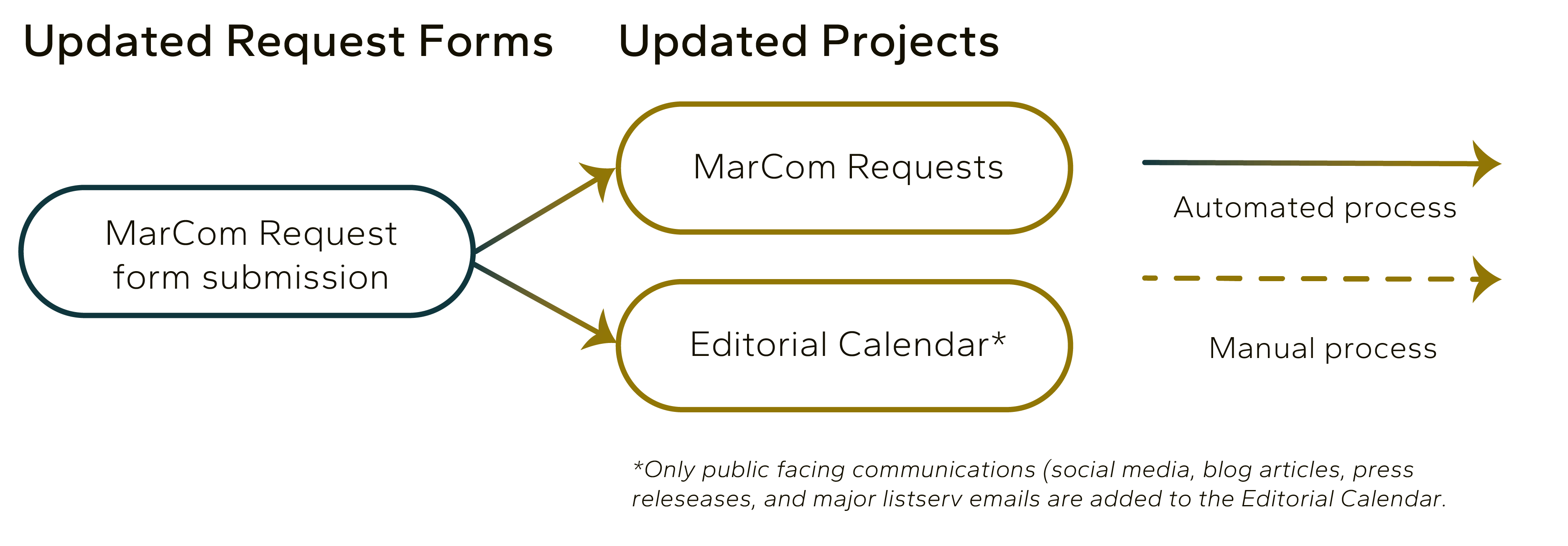
Once my short-term patches were in place, I began meeting with staff to discuss their pain points with the submission and tracking process. With each MarCom team member responsible for fulfilling the request, I walked through their workflows, discussed pain points, and learned which form fields were necessary and why. From there, I was able to create one form and whittled down the form’s fields to five—shorter than many of the standalone legacy forms it replaced.
The form allowed users to select multiple request types, which triggered backend automation for tracking and management. Every single request now lives in one location, giving the MarCom team a much more holistic view of all requests and the status of various deliverables. Furthermore, interdepartmental stakeholders are able to easily filter request types to view only their submissions. Any public facing communications are automatically added to the Editorial Calendar, color coded and filterable.
Outcomes
When the updates launched, the improvements were observable almost immediately. Times to fill out a request dropped up to 87% and the team consistently received feedback that staff were spending less time tracking the status of their requests. The MarCom team also had a more robust ability to adjust strategies, optimize deployment dates, and provide more accurate turnaround estimates on larger scale projects and campaigns that required MarCom support, but did not come in through form submissions.